
+- Discovery Gaming Community (https://discoverygc.com/forums)
+-- Forum: Role-Playing (https://discoverygc.com/forums/forumdisplay.php?fid=9)
+--- Forum: Official Player Factions (https://discoverygc.com/forums/forumdisplay.php?fid=60)
+---- Forum: Edge Worlds (https://discoverygc.com/forums/forumdisplay.php?fid=72)
+----- Forum: (\^/) Phoenix (https://discoverygc.com/forums/forumdisplay.php?fid=616)
+------ Forum: Pytheas Exploration Phalanx (https://discoverygc.com/forums/forumdisplay.php?fid=751)
+------ Thread: Pytheas Exploration Network (/showthread.php?tid=211135)
Pytheas Exploration Network - Phoenix - 03-01-2026
![[Image: rMuTljW.png]](https://i.imgur.com/rMuTljW.png)
![[Image: kl1UkkY.png]](https://i.imgur.com/kl1UkkY.png)
Welcome to the Pytheas Exploration Phalanx Network. Please submit your exploration reports and discoveries here; we will then centralize them on our dedicated servers.
Please use the following template:
![[+]](/forums/images/collapse_collapsed.png "[+]") Template
TemplateRE: Pytheas Exploration Network - Soban - 03-01-2026
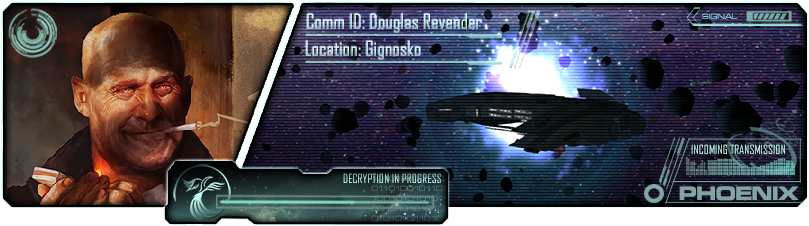
Ah, finally, the servers are online. Time to offload some reports.
Transmitting.
Omega-55 — Report 1
![[Image: o55Rec.png]](https://i.postimg.cc/C5dS5pJb/o55Rec.png)
Fleet and officers/members involved
- Douglas Revender, Captain of the (\^/) Gignosko — Corvo-class
Base of origin
(\^/)Rhamnousia — Nephilim-class
Supplies needed
- 3 days of basic provisions
- 100 units of H-Fuel
- 50 scanner batteries
Budget
100,000 credits (supplies + crew wages)
Logbook
03/06/836: Report 1
With the rumors of jump holes shifting, and new opportunities opening up, HQ asked for exploration work: locate a viable site for a new station in the Omegas.
We linked up with Rhamnousia and her escort group today. Preliminary scouting ruled Omega-41 out, leaving Omega-47 and Omega-55 as the remaining candidates.
Yes, Omega-55 is a war zone. No, that didn’t matter once the hearsay started circulating about three new jump holes and “vast riches.” HQ decided we try Omega-55 first, for the following reasons:
- Positioning: in the middle of the suspected jump-hole cluster, meaning at most one system to cross to reach Deep Omega.
- Logistics: Bornholm may be a smuggler’s hub, but it can still receive ordered goods if our trade fleet is tied up elsewhere.
- Security balance: the presence of Red Hessians and the Core keeps Corsairs and other wild elements from having free rein. Our workable terms with both could matter if we need help.
- Market advantage: less competition. IMG is rooted in Omega-47 and has been quiet about Deep Omega. If this is real, Omega-55 is our best shot at arriving first and setting the terms.
As for survey space: the northern region is off-limits, and anything near Core/Hessian installations stays untouched unless HQ wants a diplomatic incident. That leaves the south for mapping and resource assessment.
I’m setting course for the Kattegat Lava Field.
Heavy radiation confirmed on approach. We conducted a perimeter sweep without entry and kept the ship outside the worst of it.
Visuals: a dense debris belt and a planetoid at the center of the field. Entry will require either a safer vector or heavier shielding. Current tolerance is not sufficient for prolonged work inside.
Preliminary measurements: the field spans roughly 30k across, centered around the planetoid. Its ovoid distribution suggests a second gravitational influence. My best guess is a jump hole or similar anomaly, but I’m not calling it until we get clean scans.
Radiation on the border sits around 1,000–2,000 roentgens/hour. Expected intensity near the planetoid: 8,000–10,000 roentgens/hour.
Whether the planetoid and surrounding lava-rock bodies are intrinsically radioactive or merely contaminated is still unconfirmed.
Cartography and scans
![[Image: O55Lava-Outside.png]](https://i.postimg.cc/Rhq4hxGc/O55Lava-Outside.png)
First picture of the field not completely toasted by rads for once.
Due to radiation interference, figures below remain approximate:
Position: C7/8 (centered)
Field size: ~42k length / ~32k width
Contents: planetoid; lava-rock bodies; additional gravitational object (unconfirmed)
Planetoid: composition unknown; size unknown
Field composition: unknown; likely radioactive material present
Transmitting.
Omega-55 — C7/8 Kattegat Lava Field — Report 2
![[Image: o55Lavafield.png]](https://i.postimg.cc/x8qn8VgM/o55Lavafield.png)
Fleet and officers/members involved
- Douglas Revender, Captain of the (\^/) Gignosko — Corvo-class
Base of origin
(\^/) Rhamnousia — Nephilim-class
Supplies needed
- 3 days of basic provisions
- Anti-radiation drugs
- 100 units of H-Fuel
- 50 scanner batteries
Budget
105,000 credits (supplies + crew wages)
Logbook
09/06/836: Report 2
(\^/)Rhamnousia fitted us with an additional shielding layer, part of the package deployed to support the fleet and local operations. We also received fresh hazmat suits.
I used the downtime to speak with a local Junker. The planetoid is called Aarhus. He said there was fighting there—something involving the Core—and then shut down hard. Touchy subject. I didn’t push. I’m patient with rocks and radiation; people are a different hazard.
Second run: we pushed in close to Aarhus. Radiation matched our projections and the new shielding kept us operational within limits. We launched one probe; radiation corruption degraded part of the telemetry. We’ll make another pass once we’re clear of today’s safe dose.
Cartography and scans
![[Image: o55wreck2.png]](https://i.postimg.cc/Y0jM0B8z/o55wreck2.png)
Leftovers from the battle the Junker hinted at.
Due to radiation interference, figures below remain approximate:
Position: C7/8 (centered)
Field size: ~42k length / ~32k width
Contents: planetoid; lava-rock bodies; additional gravitational object (unconfirmed)
Planetoid: ~200 km diameter; composition shows ~10% uranium (prelim.)
Field composition: lava/molten rock with elevated uranium content, ~20–30% in sampled returns (prelim.; radiation interference present)
Transmitting.
Omega-55 — C7/8 Kattegat Lava Field — Report 3
![[Image: o55JH.png]](https://i.postimg.cc/Hnjdn138/o55JH.png)
Fleet and officers/members involved
- Douglas Revender, Captain of the (\^/) Gignosko — Corvo-class
Base of origin
(\^/) Rhamnousia — Nephilim-class
Supplies needed
- 3 days of basic provisions
- Anti-radiation drugs
- 100 units of H-Fuel
- 50 scanner batteries
Budget
105,000 credits (supplies + crew wages)
Logbook
25/06/836: Report 3
With Livadia running at full capacity, we managed to get our hands on some of the latest armor Donagan cooked up. That let us push deeper into the field and stay there longer without cooking the crew.
We’ve finalized the preliminary survey of the asteroid field, and we already hit “gold.” Uranium, to be precise. High-grade, plentiful, and sitting in the rock like it wants to be mined. Easy extraction, straightforward processing. If Deep Omega turns out to be a death trap, this field alone can still pay for the expedition.
We moved on the gravitational anomaly. At first glance it looked like a collapsed jump hole, then the readings started disagreeing with what my eyes were seeing. Massive irregularities. Not as severe as the Blackout incident, but the pattern is wrong. Fluctuations that don’t match normal drift, and not consistent enough to be simple turbulence.
A few hours in, the instruments spiked again. Then the thing lit up.
An intense burst of unknown radiation, sharp, violent, and brief, and the rift reactivated. Later, Freeport 5 Zoners reported a similar burst detected in Omega-41. Our scouts also confirmed that Omega-41 did, in fact, have a collapsed jump hole on record.
So here’s my working conclusion: the Deep Omega access point isn’t stable. It’s gated—likely by some combination of Fisher rotation effects and intermittent radiation events that shove the rift open or snap it shut. Whether that “random burst” is natural or someone else’s problem wearing a lab coat, I don’t have enough data to pretend certainty.
But we got what we came for. The entrance is real. Deep Omega access is confirmed. First step of the expedition: successful.
Back aboard the Nephilim, I overheard HQ already mobilizing crews to start construction on a new base near Bornholm. They’re aiming for maximum secrecy, quiet build, minimal broadcasts, under the locals’ radar.
I don’t know how they expect to pull that off in a system where everyone listens to everyone, but they clearly don’t want Corsairs sticking their hands in our business again.
In the meantime, they’ve tasked us with the next part: push into Deep Omega, chart a viable course toward the deepest reachable sectors, and map anything worth keeping quiet. New rumors came in with returning explorers—half of it is probably bar talk, but it’s enough for HQ to want hard data instead of stories.
Cartography and scans
![[Image: o55JHsquare.png]](https://i.postimg.cc/j2Ct2Yvf/o55JHsquare.png)
Objective in sight. Mission accomplished.
Due to radiation interference, figures below remain approximate:
Position: C7/8 (centered)
Field size: ~42k length / ~32k width
Contents: planetoid; lava-rock bodies; gateway to Deep Omega when aligned
Planetoid: ~200 km diameter; composition shows ~10% uranium (prelim.)
Field composition: lava/molten rock with elevated uranium content, ~40–50% in the Aarhus-adjacent belt — exploitation is a go.

RE: Pytheas Exploration Network - Soban - 03-15-2026
Hello,
Time to let the cat out of the bag. HQ has lifted the secrecy seal on the Deep Omega mission.
If you were wondering where Edward Hawthorne, Lukas Reinhardt, Julien Moreau, and Hiroshi Takeda are.
They are dead.
Reduced to atoms or still orbiting Fischer for a span of time none of us can begin to measure.
We will hold a ceremony planetside on Palmyra soon.
Douglas out.
Starting upload.
Omega-47 — Report 1
![[Image: o47Madera-Large.png]](https://i.postimg.cc/jdH1ZSTv/o47Madera-Large.png)
Fleet and officers/members involved
- Douglas Revender, Captain of the Corvo (\^/) Gignosko
- Martial Revender, Pilot of the Hawfinch (\^/)Rhaphios
- Bob Donager, Pilot of the Hawfinch (\^/)Gagyla
- Hasegawa Tōyō, Captain of the Dromedary (\^/)Ichthus
Base of origin
(\^/)Rhamnousia — Nephilim-class
Supplies available
- 60 days of basic provisions
- 450 units of H-Fuel
- 10 ZC-P-12 probes
- 2 ZP-P-1 armored prototype probes
Expense
870,000 credits (supplies + crew wages)
Logbook
28/06/335: Log 1
Long-range scanners detected a new shift at the Omega-55 entry. The probe we sent confirmed that the rift had returned to a collapsed state. Freeport 5 also confirmed that the rift in Omega-41 showed no significant changes, which led us to believe that the new opening was now in Omega-47.
That means the Deep Omega expedition is back on. We’ll be following the trail left by Expedition 13.
The Science Department equipped us with an upgraded variant of the gravimetric arrays first used by the Eidolon Star. With luck, they’ll help us read the shifting corridors without getting us killed.
The techs swore the new arrays were “stable enough for field use,” which in science-division dialect means they probably won’t explode until the second week.
We expect to reach Madeira Base for resupply before pushing deeper, likely within a day. Maybe more. Trade and Contracts also asked us to gather samples along the way and start preliminary analysis, because apparently even the edge of nowhere still needs paperwork.
So here we are, launching from the Nephilim while the others begin work on our new station in the area: Sparta Complex.
The tricky part will be reaching the Omega-47 jump hole between the twin suns. Initial scans indicate that a narrow band between the two coronas is navigable. “Navigable” in this case meaning “probably won’t boil us alive if the pilot doesn’t twitch.”
Crew mood is still decent. Excited, mostly. A few of the newer hands are trying too hard not to look impressed every time someone says “Deep Omega” out loud. I’ll give them two days before awe turns into fatigue and bad coffee.
Ship status: Gignosko fully operational. Fresh maintenance cycle completed aboard Rhamnousia before departure. Port-side thermal sinks were replaced, gravimetric array mount reinforced, and one of the scanner housings kicked back into alignment after Bob swore at it for ten minutes. Apparently that still counts as engineering.
29/06/335: Log 2
We reached the Akioud Cloud. The scanners picked up numerous signals, enough to confirm that this sector sees more traffic than expected.
Unfortunately, we can also confirm Corsair activity this far into the Omega cluster. That matches what we overheard earlier from a Red Hessian: Casablanca Base is still active somewhere around the gas giant Rabat. So far, they’ve ignored us, likely too busy protecting what looks like a resupply corridor for that base.
We collected rock samples from the molten asteroids. Preliminary tests revealed only trace amounts of titanium, not enough to justify mining. However, increasing concentrations of cobalt were detected farther south.
I’ve already sent a communication recommending a mining vessel be dispatched to survey the southern edge more thoroughly. It’s not that we or Sirius are starving for cobalt with Omega-7 still around, but an independent and reliable source would do wonders if we’re serious about justifying a permanent station in Omega-55.
The cloud itself is a bastard to navigate. Not the worst I’ve seen, but dense enough that the snubs had to fly wide and cautious. Martial called it “beautiful.” Bob called it “one bad engine flare away from becoming modern art.” I’m with Bob on this one.
One interesting note: the farther south we pushed, the more the scanner hum changed pitch. Barely noticeable at first, then enough to make the onboard boffin ask for a second recording pass. Might be nothing. Might be the field composition changing. Might be one more weird thing waiting to bite us later.
Anyway, our time in that dense cloud is over. Samples are secured for more extensive tests later. Time to head for Madeira.
30/06/335: Log 3
We reached Madeira without major incident. A few Coalition and IMG patrols gave us the usual curious stare, but nothing worth noting.
Madeira has that familiar frontier smell: hot machinery, stale air, tired people pretending prices aren’t criminal. One of the dockworkers took one look at our manifests and laughed in my face before charging us anyway. Good to know civilization survives out here. We resupplied the ships. Expensive, of course, but this is the far edge of the Omegas nothing out here comes cheap.
We spent a few hours lurking around and studying the installation. It appears primarily geared toward exploiting the El Aaiún Field. Aside from a few decent nodes, though, it doesn’t look especially lucrative. They either don’t know about the probable cobalt deposits or don’t care.
What did get their attention was the shifting signal we picked up back in Omega-55. That alone means this expedition wasn’t a waste.
Crew took the chance to stretch their legs and complain about station food, which tells me morale remains healthy. Hasegawa managed to secure extra filters without asking what they cost first, which means I’ll probably discover the damage in the Expense report later.
Time to leave Omega-47 and sail into the unknown.
Cartography and scans
![[Image: Akioud-Sm.png]](https://i.postimg.cc/MTwM05mn/Akioud-Sm.png)
Akioud Cloud
Position: G4 (center)
Field size: Unknown
Contents: molten-rock bodies
Field composition: Titanium traces, Cobalt (15%+)
Supplementary note: Southern sample line shows growing cobalt concentration across multiple collection points. Additional survey strongly recommended before any industrial commitment is made.
Transmitting.
Cayman — Report 1
![[Image: Cayman-Large.png]](https://i.postimg.cc/rpfXgFS3/Cayman-Large.png)
Fleet and officers/members involved
- Douglas Revender, Captain of the Corvo (\^/) Gignosko
- Martial Revender, Pilot of the Hawfinch (\^/)Rhaphios
- Bob Donager, Pilot of the Hawfinch (\^/)Gagyla
- Hasegawa Tōyō, Captain of the Dromedary (\^/)Ichthus
Base of origin
(\^/)Rhamnousia — Nephilim-class
Supplies available
- 55 days of basic provisions
- 830 units of H-Fuel
- 10 ZC-P-12 probes
- 2 ZP-P-1 armored prototype probes
Expense
990,000 credits (supplies + crew wages)
1,000,000 credits to purchase a local chart
Logbook
05/07/335: Report 1
These last few days have been eventful, to say the least. We finally entered the Deep Omega.
First impression: it’s red. Red everywhere. After a few days in the place, that color is practically burned into my retinas.
As expected, we were not the first ones here. We spotted freelancers, fellow Zoners (more on that later) and even Coalition and Red Hessian traffic. A very red system, in every possible sense.
More worrying: we also identified Corsair and Infected presence. That alone will make any future expedition — or worse, any exploitation attempt — far more expensive.
We exited Omega-47 into what the locals call the Tierra Nebula. First scans showed no immediately interesting resources, but the long-range scanners did pick up an anomaly. We logged its rough position for a later expedition. Visibility in Tierra was miserable. The kind where the nebula doesn’t just block your view, it feels like it’s pressing against the canopy and daring you to blink first. Good place to hide something. Or lose something.
As soon as we cleared the cloud, we picked up a familiar signal bearing Zoner markings: The Intrepid Maiden.
So the De Sousa / Maiden clan beat us to this sector. They’re currently orbiting Fuere and offering shelter. For a price, naturally.
We managed to haggle system and regional data from them for a whopping one million credits, plus the promise of future supplies. They also handed over a copy of the old Expedition 13 databank.
That alone saved us a tremendous amount of time. Thanks to it, we now know the entry point to a deeper system.
I still think the million was robbery, but it was informed robbery, which is somehow more respectable. Jonathan would probably call it “a valuable strategic acquisition.” I call it getting skinned politely by family with docking rights.
After a few days talking with the locals, we headed toward Omega-2. Unfortunately, we couldn’t secure any real resupply. The Maiden clan is very tense about its stockpiles. Just glancing toward a storage room is enough to make people start watching your hands.
So full exploration of Cayman will have to wait. The southern gas giant, its moon, and the Mendez Anomaly will be for another trip.
Crew mood dipped a little here. Nothing dramatic, just the usual frustration of seeing promising leads and not having the fuel, time, or local goodwill to chase them. Bob took it by trying to charm one of the Maiden quartermasters. He failed so hard it almost counted as sabotage.
Ship status remains acceptable. Minor dust scoring on forward plating. Starboard passive sensor mast needed cleaning twice in one day thanks to fine particulate buildup from the nebula. No structural damage worth whining about.
Cartography and scans
![[Image: cay-tierra.png]](https://i.postimg.cc/SRSn3GRR/cay-tierra.png)
Tierra Nebula
Position: A4/5 (center)
Nebula size: Unknown
Contents: dust and small asteroids of negligible value
Point of interest: Mendez Anomaly in B3, if local intel is accurate
Field composition: light gases and metallic traces in very low concentrations
Supplementary note: Navigation visibility poor. Suitable as concealment terrain, but little to recommend it for resource extraction.
Position: A4/5 (center)
Nebula size: Unknown
Contents: dust and small asteroids of negligible value
Point of interest: Mendez Anomaly in B3, if local intel is accurate
Field composition: light gases and metallic traces in very low concentrations
Supplementary note: Navigation visibility poor. Suitable as concealment terrain, but little to recommend it for resource extraction.
![[Image: cay-fuego.png]](https://i.postimg.cc/2yWCHbFc/cay-fuego.png)
Fuego Nebula
Position: H4/5 (center)
Nebula size: Unknown
Contents: gases and molten asteroids
Point of interest: Omega-2 entry at G6
Field composition: elemental hydrogen with trace amounts of heavier gases; asteroid content appears of low value pending further samples
Note: The nebula appears to be slowly collapsing and heating up. On a geological timescale, it may eventually form a star
Supplementary note: Thermal patterns inside the nebula are uneven but not immediately hazardous to shielded passage. Further scans recommended before any heavy traffic route is established.
Position: H4/5 (center)
Nebula size: Unknown
Contents: gases and molten asteroids
Point of interest: Omega-2 entry at G6
Field composition: elemental hydrogen with trace amounts of heavier gases; asteroid content appears of low value pending further samples
Note: The nebula appears to be slowly collapsing and heating up. On a geological timescale, it may eventually form a star
Supplementary note: Thermal patterns inside the nebula are uneven but not immediately hazardous to shielded passage. Further scans recommended before any heavy traffic route is established.
![[Image: Fuereml.png]](https://i.postimg.cc/G3F0SQJm/Fuereml.png)
Planet Fuere
Position: E2
Diameter: 30,216 km
Mass: 9.89 × 10e26 kg
Terrain: hot gases
Temperature: N/A
Escape velocity: 15.42 km/sec
Contents: Unknown gases
Other: The Intrepid Maiden orbits this gas giant
![[Image: Maidensml.png]](https://i.postimg.cc/hGNFNZ5x/Maidensml.png)
The Intrepid Maiden
Position: D2
Class: Oasis
Gravity: Complete
Docking: Yes
Amenities: Restricted
Crew: 40
Owner: De Sousa Zoner family
Supplementary note: Functional station with clear stock discipline and tight internal controls. Hospitality available, trust not included.
![[Image: BANDBsml.png]](https://i.postimg.cc/d3KbVkvh/BANDBsml.png)
Planet Braillia and Bactun
Position: D6 and E6
Diameter: Unknown
Mass: Unknown
Terrain: Unknown
Temperature: Unknown
Contents: Unknown gases
Other: Maiden data indicates Bactun is a volcanic moon
Transmitting.
Omega-2 — Report 1
![[Image: Omega2Large.png]](https://i.postimg.cc/9Q7NrPX7/Omega2Large.png)
Fleet and officers/members involved
- Douglas Revender, Captain of the (\^/) Gignosko — Corvo-class
- Martial Revender, Pilot of the Hawfinch (\^/)Rhaphios
- Bob Donager, Pilot of the Hawfinch (\^/)Gagyla
- Hasegawa Tōyō, Captain of the Dromedary (\^/)Ichthus
Base of origin
(\^/)Rhamnousia — Nephilim-class
Supplies available
- 52 days of basic provisions
- 710 units of H-Fuel
- 8 ZC-P-12 probes
- 2 ZP-P-1 armored prototype probes
Expense
990,000 credits (supplies + crew wages)
1,000,000 credits to purchase a local chart
Logbook
06/07/335: Report 1
Omega-2 greeted us with the strangest damn star I’ve ever seen. That one alone deserves a full expedition. It has more blackspots on it than my teenage nephew has on his face.
We exited Cayman into the Harstad Nebula, and — surprise — it’s red again. At least less violently so than Cayman. This one has more of an eerie glow to it than an angry one.
We gathered samples from the lava fields. Initial tests showed nickel, iron, and other metals still to be determined. Even if it turns out not to be worth exploiting, the volcanic activity alone is worth seeing.
The Hawfinch flew low along one of the brighter molten veins to get better readings. Looked impressive on the scope. Less impressive when the heat bloom made half the cockpit smell like scorched insulation for the next hour.
After a day spent in the field, we headed toward the supposed entrance to Omega-97. The De Sousa warned us about it: a maze of severe danger, laced with more unknown anomalies.
On the way to the rift, we detected a lone planet and another asteroid field in the southern part of the system. Once again: more questions than answers. At least we’re finally out of anything red.
07/07/335: Report 2
Nothing particularly significant turned up on the way to the rift. Long-range scanners did, however, pick up a small planet orbiting a blue dwarf.
Approach to Tija and Bahir Dar went smoothly. No major gravitational anomalies were detected near either body.
Tija reminded me a bit of Palmyra: vast ice plains cut through by crevasses kilometers deep. Quiet, cold, and the sort of place that kills you politely.
Bahir Dar is the opposite—fiery, unstable, and ugly in all the right ways.
Any proper expedition to either body will require very different equipment. Initial scans revealed nothing immediately valuable, and the probes failed too quickly to return useful deeper data.
One probe over Bahir Dar didn’t even fail cleanly. It kept transmitting broken telemetry and heat noise for twenty-three seconds after the hull should have slagged. Longest twenty-three seconds of the science officer’s week. He grinned the whole time, which is how you know they’re all damaged in the head.
Time to jump into the unknown. Our reliable charts end here. Everything beyond this point is stitched together from whatever fragments Expedition 13 left behind.
Crew mood before entry into Omega-97: quieter than before. Less chatter in the mess. More people rechecking harnesses and pretending they aren’t. Nobody asked to turn back. I’ll give them that.
Cartography and scans
![[Image: Harstad-Sml.png]](https://i.postimg.cc/NMf47Rt4/Harstad-Sml.png)
Harstad Nebula
Position: A/B4 (center)
Nebula size: Unknown
Contents: lava field and red dust
Field composition: nickel, iron, and other metals
Supplementary note: Visually striking but currently of uncertain commercial value. Thermal activity may justify future geological study if resources permit.
![[Image: Tand-Bsmall.png]](https://i.postimg.cc/4dd6hZvP/Tand-Bsmall.png)
Planet Tija || Moon Bahir Dar
Position: F5 || F6
Diameter: 6,471 km || 2,890 km
Mass: 3.12 × 10e24 kg || 1.72 × 10e22 kg
Terrain: Arctic || Volcanic
Temperature: -220°C to -180°C || 700°C to 1,400°C
Escape velocity: 8.4 km/sec || 3.4 km/sec
Note: Prepare probes accordingly for the recorded temperature extremes.
![[Image: M171Sal.png]](https://i.postimg.cc/wjpbRytH/M171Sal.png)
Star M-171
Type: M6
Luminosity: V
Color: Red
Temperature: 3K
Mass: 1.45 × 10e30 kg
Diameter: 0.92 × 10e7 km
Unknowns
- Southern asteroid field
- Southern planet
- Blue dwarf and orbiting planet
- Northern field
Transmitting.
Omega-97 — Report 1
![[Image: Asslarge.png]](https://i.postimg.cc/ZqVTMhkY/Asslarge.png)
Fleet and officers/members involved
- Douglas Revender, Captain of the Corvo (\^/) Gignosko
- Martial Revender, Pilot of the Hawfinch (\^/)Rhaphios
- Bob Donager, Pilot of the Hawfinch (\^/)Gagyla
- Hasegawa Tōyō, Captain of the Dromedary (\^/)Ichthus
Base of origin
(\^/)Rhamnousia — Nephilim-class
Supplies needed
- 41 days of basic provisions
- 580 units of H-Fuel
- 5 ZC-P-12 probes
- 2 ZP-P-1 armored prototype probes
Expense
990,000 credits (supplies + crew wages)
1,000,000 credits to purchase a local chart
Logbook
15/07/335: Report 1
Well, shit.
I expected trouble, but this place is a solid eight out of ten on my personal shitshow scale.
When we came through, for a second I thought I’d been dropped inside the colon of a cancerous Corsair. Damn, I actually miss the red glow of Cayman. This system triggers every bit of bathophobia I didn’t know I still had.
The asteroids here remind me of the Kattegat Lava Field, except on steroids. Radiation goes off the charts the moment you leave the safe corridors.
The probe we sent before it melted returned readings of roughly 604.4 gray per hour. Whatever these asteroids are hiding, it doesn’t feel natural.
I’m not even sure we have the technology to exploit whatever energy source is bleeding through this place. Maybe the Science Department will start drooling over it. Maybe it’ll kill them too.
The corridor itself feels wrong in a way that is hard to write down cleanly. It is not just narrow—it feels used, like something big has been scraping through the field for a very long time. The rock around it is smoother than it should be, peeled back and cooked into glassy scars.
Speaking of hidden things, the scanners are nearly useless beyond 5k. Everything turns to gibberish. Our onboard boffin thinks the noise masks at least one sizeable astral body, plus a whole mess of anomalies.
Turns out he was right.
We’re barely into the system, our navmap is already half-asleep, and we’ve already found two anomalies. The first nearly swallowed the safe corridor whole. So that’s probably how the corridor was carved in the first place. We named it, with all the imagination we could muster, Anomaly 1-D6. It has clear destructive capability and appears to move slowly through the field, cutting its own path.
We encountered another one in the dogleg: Anomaly 1-E7. Smaller, still deadly. Judging by the damaged Pilgrim nearby, someone else learned that the hard way.
We gathered what data we could. The science crew will now try to phase our scanners to the background noise and reverberations these things throw through the asteroid field.
As for the wreck, we could only partially make out the name, Plotyma or something close to it. We did not attempt boarding. Too much radiation, too much gravitational distortion, not enough desire to die.
Crew mood took a hit the moment we entered. Not panic—worse than panic, really. The kind of silence you get when everyone onboard is pretending the system is normal because saying otherwise would make it real. Even Bob stopped joking for a while, which is how I knew Omega-97 had everyone by the throat.
Ship status: shield drain above forecast, hull still holding. Scanner arrays are taking constant interference spikes and had to be power-cycled twice. Internal air scrubbers are also working harder than usual—something in the field leaves a metallic tang in the vents, even with the hull sealed. The crew says it smells like blood and hot copper. They’re not wrong.
We’ll resume the push toward the deeper systems. Supplies are already taking a hit. Radiation is chewing through equipment faster than planned.
16/07/335: Report 2
Didn’t expect to report again this quickly.
We were closer to our objective than expected, and for once no anomalies slowed us down. Thanks to the brief study on the previous anomalies, we managed to partially filter scanner and probe data.
We triangulated three points of interest for future investigation:
- One massive gravitational object, estimated at 5–7 × 10e24 kg. Our scanner operator believes it may be a planet, as it produces relatively low noise and only faintly echoes nearby disturbances.
- One additional gravitational anomaly, harder to classify than anything we’ve recorded so far.
- One cluster of... something. Multiple overlapping signals or “voices,” if you want the unsettling version. Like a chorus of crushing flesh.
The last one unsettled more than just the science team. We replayed the signal twice in the lab and once in the cockpit. On the third pass one of the younger techs quietly asked us not to do it again. I agreed. I’m patient with bad data, not with hearing rocks scream.
One small anecdote for the archive: Hasegawa swore he saw movement outside the port canopy while we were drifting at reduced thrust. Not on scanners. Not on optics after replay. Just one dark shape crossing where no shape should have been. Could be fatigue. Could be reflected plasma from the field. Could be Omega-97 playing games. I logged it anyway.
Time to head for Fischer.
Cartography and scans
![[Image: O97-Nub.png]](https://i.postimg.cc/C5ykz8cW/O97-Nub.png)
Nubian Cloud
Position: Everywhere
Nebula size: Unknown
Contents: High concentration asteroid and particulate field
Field composition: Unknown but highly radioactive
Supplementary note: Safe corridors appear carved or maintained by recurrent anomalous activity. Any civilian or industrial route planning here should be considered temporary at best.
![[Image: o97Anno1.png]](https://i.postimg.cc/rmqzb9YF/o97Anno1.png)
Anomaly 1-D6
Position: D6
Dangerosity: 5 out of 10 on the Newberg Scale
Anomaly Type: Radioactive
Composition: Unknown
Supplementary note: Big bastard. Drifts slow, cooks everything around it, and seems to carve its own path through the field. Fair chance the nearby corridor exists because this thing keeps chewing at the rocks. Do not get clever near it.
![[Image: O97-Ano1E7.png]](https://i.postimg.cc/0QZrqJLN/O97-Ano1E7.png)
Anomaly 1-E7
Position: E7
Dangerosity: 4 out of 10 on the Newberg Scale
Anomaly Type: Radioactive and gravitational
Composition: Unknown
Supplementary note: Smaller, meaner, and fond of dragging things where they should not go. Radiation is bad enough; the gravimetric pull is what makes it lethal. The wreck nearby is proof enough.
![[Image: O97-ptoly.png]](https://i.postimg.cc/nzRZ28jJ/O97-ptoly.png)
Ptlolemyâs Rest
Position: E7
Wreck: Pilgrim-class wreck
Status: Boarding and exploration appear possible
Condition: Damaged, but sufficiently intact for a dedicated recovery or survey team
Supplementary note: We could probably board it and see what’s left inside, assuming the radiation doesn’t roast the team first and the local anomaly doesn’t decide to get playful.
Transmitting.
Fischer — Report 1
![[Image: Fischer-Large.png]](https://i.postimg.cc/x1Y8p2x6/Fischer-Large.png)
Fleet and officers/members involved
- Douglas Revender, Captain of the (\^/) Gignosko — Corvo-class
- Martial Revender, Pilot of the Hawfinch (\^/)Rhaphios
- Bob Donager, Pilot of the Hawfinch (\^/)Gagyla
- Hasegawa Tōyō, Captain of the Dromedary (\^/)Ichthus
Base of origin
(\^/)Rhamnousia — Nephilim-class
Supplies available
- 24 days of basic provisions
- 280 units of H-Fuel
- 0 ZC-P-12 probes
- 0 ZP-P-1 armored prototype probes
Expense
990,000 credits (supplies + crew wages)
1,000,000 credits to purchase a local chart
Logbook
17/07/335: Log 1
At last, we reached the crown jewel of the Deep Omega: Fischer.
What a sight. And what a nightmare for engines.
The constant pull was reported by every pilot as miserable. Course corrections had to be made continuously until the autopilot finally calibrated itself well enough not to kill us. Even the nearby gas giant Aesir failed to provide a safe Lagrange point for our snubs to refuel.
As for the system itself: once the scanners were properly tuned to the background noise and radiation Fischer throws off, we identified at least six stellar bodies. One of them lies on the far side of the black hole and had not been recorded before today. That alone should give a few astronomers a headache.
More worrying, the entire sector is riddled with smaller anomalies. Beautiful to look at. Very likely fatal to approach. They emit extreme heat and radiation and do not appear to behave like ordinary stellar bodies under Fischer’s gravity.
I’ll give Fischer this much: it knows how to make an entrance. The whole system feels like standing too close to a machine that was built by something smarter than you and then left running for a few million years. Even the quiet parts feel dangerous.
Crew fatigue is climbing faster here than anywhere before. Nobody gets to fully relax because the ship is always compensating. Every deck groans at a different interval, every strapped-down crate complains, every engine note sounds half a tone off. You can sleep in it, technically. Your bones won’t thank you.
18/07/335: Log 2
Due to the strain on fuel reserves, we decided to focus on the most prominent target first: the cracked planet Freyja.
Getting close to the planet is a mathematical nightmare. Fischer’s pull, combined with the motion of Freyja’s shattered crust, makes a direct approach impossible unless you’re trying to end up as debris.
Scanners indicate vast quantities of resources, but until a safe path is found that means nothing.
We searched for a way through the field and found Ilar Renn’s ship, or what was left of it.
Most of the databank had clearly been retrieved by previous expeditions, but by comparing the wreck position with the drift of nearby debris, we think we found the pattern they were following.
After several hours of aggressive mathematics, the science crew identified a gravitational weak point: essentially a void in the churning field, like a causeway through moving asteroid and core mass ejection.
We confirmed it. A winding path leads dangerously close to the planet’s exposed core.
And there lies one of Fischer’s treasures: raw formations of rare minerals. So far we estimate large concentrations of silver, gold, and platinum, with exploitable amounts of osmium on top of that.
The beauty of it is this: as chunks are slowly torn away by the surrounding gravimetric forces, there’s a short extraction window before they’re pulled back into the lethal flow.
We collected samples for deeper analysis. The channel appears stable enough for mining and logistics ships. I still have doubts about bringing an Hegemon in here, but an Archon could probably manage.
The mining potential is real enough that even the most exhausted members of the crew woke back up when the sample trays came back heavy. Nothing restores morale like the smell of future profit. A few of them were already arguing tonnage and escort needs before I told them to shut up and let us survive first.
One strange detail: near the weak point, the usual background roar of Fischer dipped for a few seconds at a time, like the whole system was taking a breath. The sensors logged it. The crew felt it. Nobody liked it.
We’re pulling away from Freyja now to rest before the most reckless part of the journey.
27/07/335: Log 3
We were close to giving up. Supplies were running low, morale wasn’t doing much better, and then the gravimetric arrays picked up a distortion that should not exist.
No visual. Nothing on extended-range optics. Just the instruments insisting something unnatural was there.
That matches fragments from Expedition 13. Something is out there.
It took us a week to calculate a survivable trajectory. Any mistake would have killed us. Then it took another two days to make sense of what the probes sent back before going silent.
Standard probes were shredded by the gravimetric forces or melted by the heat. Only the experimental probe, armored with the latest iridium composite, got far enough to tell us anything useful.
And it reached something.
That something appears almost immune to Fischer’s pull. We hadn’t expected that, so there’s a fair chance the probe slammed into the structure at full speed. The good news: if the math holds, the Gignosko’s integrity and engine profile should let us survive the same run and get back out.
The probe prototype armor held. Heat dispersion behaved exactly as intended.
The last images showed a spherical object looming over an inverted pyramid.
By day’s end, preparations for the abyss run were complete.
The (\^/)Ichthus received a full copy of all data and logs, then departed with all non-essential personnel. It will hold in Omega-2 until supplies run dry, then return to Omega-55 if we don’t.
Our two escort snubs are now clamped to the experimental wing pads of the Corvo. Everything has been triple-checked.
If this turns out to be my last log, my final words will be the same as Anaxagoras:
“Give the boys a holiday.”
Nobody laughed when I said it. That’s how I knew everyone onboard had understood the odds. Before departure, one of the engineers left a little amulets tied to the portside access ladder. Some ugly stitched pineal thing his daughter made. I let it stay. At that point I was taking blessings from wherever they came.
Ship status before the run: outer hull scorched, thermal sinks overworked, port maneuvering cluster showing delayed response under sustained gravitic shear. Still spaceworthy. Still ours. Barely polished enough to meet death with some dignity.
29/07/335 (28/07/335)
I don’t know where to start.
The bridge is full of noise —alarms, damage reports, breath, metal— but human voices had mostly run out.
We’re only a few dozen klicks from the station, and it still took us a full day to reach that position.
Hull integrity is down to 90%. Nanobots should keep us alive for now.
Both snub are destroyed. Pilot recovered.
The Gignosko lost four good men.
The “clouds” seem to have stopped pursuing us.
I need time to sort this out. Everything happened too fast.
31/07/335 (28/07/335)
On the 28th, we got visual contact with the structure.
Scanners couldn’t pierce the bubble around it, and even direct visual observation barely made sense. Light itself looked wrong around the field. The distortion was bad enough to make the whole thing feel unreal.
We reached the bubble and diverted all available power to reverse thrust to avoid ending like the probe.
For the first time since entering Fischer, we held still.
We appeared to be inside a massive Lagrange point, or something very close to one. Sound, light, background noise, the pressure of Fischer itself. Everything dropped away. It felt like the universe had been muted. Only our engines and a low humming from the structure remained.
The structure is definitely alien. Outer surface composition remains unknown.
It appears divided into two main components and three pyramidal satellites.
The upper main component is some sort of decahedron and a cube merged together, rotating rapidly and changing direction unpredictably. It emits unknown matter. Our current theory is that it maintains the bubble, so nobody is touching that.
The lower structure is a massive tetrahedron, with its smaller upper face supporting the floating decahedron, and its lower point descending toward a singularity-like rift.
The three smaller tetrahedrons are positioned around the base vertices. One still showed the impact mark from our probe.
We spent an entire day recording everything and touching nothing. With no need to fight Fischer’s pull, all spare energy went into scanners and passive listening systems.
At day’s end, we unclamped the two snubs and sent one down to the probe impact site.
The moment Bob recovered the probe databank and the first samples, hell broke loose.
Multiple contacts appeared from nowhere. No alarms at first, because they registered as drifting gas clouds. Then each cloud bonded with some kind of floating module, and everything went to hell properly.
Either the clouds generated the modules, or the structure launched them. Hard to tell.
Once linked, the modules turned the clouds into spheres of energy. We observed two main module configurations: either four three-dimensional cross-frames or six urchin-like nodes stabilizing the sphere.
We tried to establish contact while they were still forming. The instrument data suggested a DVK-like structure, not Nomad. We thought, stupidly, that they might be drones or maintenance units.
Then they opened fire.
Slow plasma bolts. Missiles. Mine-like electrical clouds. Seven contacts in total.
Martial reacted first and engaged the unit attacking the landed snub. It did nothing. Continuous Fury-gun fire barely scratched them.
The Hawfinch was destroyed the moment its shield failed. Their railgun fire tore it apart after one of the “missiles” disabled the ship outright. Thankfully, Bob was still close to the crash site.
I managed to improvise a plan to get Bob and the samples back.
We determined quickly that the constructs were not sentient. They followed predictable attack cycles. The urchin-pattern units made direct attack runs on the Corvo, while the cross-pattern units focused on the remaining snub.
As long as shields held, the incoming fire and mines were survivable.
We baited a synchronized firing pass, waited for them to overshoot, then pushed close enough to the structure for Bob to cross by jetpack directly into the open cargo bay.
It worked.
It did not work as well for the other snub. Approaching too close triggered a proximity defense effect that reset engines and damaged both shield and hull.
It took what felt like forever (really only minutes) for our main battery to destroy one of the clouds.
The modules are the weak point, but they rotate constantly around the moving energy sphere, making clean shots difficult.
Once a module cluster was destroyed, the cloud collapsed instantly into residual unknown gases and exotic matter.
Armed with that knowledge, we destroyed the rest and collected what we could.
At that point we decided to evacuate immediately. The rift beneath the structure appeared to be the safest route out. If you tried to leave the bubble normally and one of those guardians hit you, your engines would stall and Fischer would finish the job for them.
The Rhaphios had taken too much damage to be reclamped to the prototype mount, so we prepared a remote-use contingency.
And yes, we needed it.
As we moved toward the rift, the structure emitted an ominous resonance and began generating more of those energy spheres around the exit, almost as if it understood what we intended.
We used the crippled fighter as bait and sent it straight toward the structure. It worked, partly. They tried desperately to kill it before it reached the weird decahedron.
They succeeded. Just before we reached the rift ourselves. Remote piloting made the flight too predictable. One engine was destroyed and we lost contact with the craft entirely.
Still, it bought us time.
You served well, Rhaphios.
Even then, we were not safe.
Despite a defensive "riposte" mine screen, one charged plasma bolt hit the portside living quarters.
Three members of the Research and Exploration Department were vaporized. One member of Security and Defense is still missing.
May they rest in peace. Their names and service will be engraved at the memorial on Palmyra:
Edward Hawthorne, Lukas Reinhardt, Julien Moreau, and Hiroshi Takeda.
Nanobots began reinforcing the hull immediately, and automatic systems sealed the damaged bulkheads.
Even with a section of the ship missing, structural integrity remained barely sufficient to withstand Fischer.
So we entered the rift without a second thought.
We emerged from a previously undetected rift only a few klicks from the alien structure, but farther out, beyond the worst of Fischer’s pull. Cruise engines engaged immediately and began dragging us free.
As of now, we are nearly clear. If nothing else goes wrong, we should reach the system exit tomorrow.
I have rewritten this part three times already and it still feels too small for what happened in there. The bubble was quiet in a way space should never be. The guardians moved like tools, not animals—like functions. And when they started firing, nobody onboard had time to be brave. We just got busy surviving.
One detail I do not want lost: when Bob crossed back by jetpack, he came in spinning, half-blind, dragging that sample case like it was the last holy relic in Sirius. The whole cargo deck grabbed him at once. Nobody said a word until the inner hatch sealed. Then half the bay started swearing at him out of relief.
01/08/335 (29/07/335) - 1
At roughly 20k from the Omega-97 rift, we picked up a signal we now know all too well.
Those plasmic bastards can leave the bubble, and they’re faster than we are.
Three of them were waiting near the jump hole.
We powered down everything and hid in Aesir’s shadow. We’re working a plan with what little we have left. If the shield fails, we’re done. The ship won’t survive the gravimetric stress in that state.
We cannot fail. Not after what we lost. Not with this much data and this many samples aboard.
The crew barely slept. Some tried, strapped into whatever corner still existed. Others just sat with helmets off, staring at bulkheads and pretending not to listen for the next alarm. I checked on engineering twice. They had already started naming patched conduits after dead philosophers, which is how that department copes when things get ugly.
01/08/335 (29/07/335) - 2
We fired the last of the prototype probes at them.
The whole thing ended in anticlimax.
They took the bait and followed it. We recorded useful reaction data while they did. Still, some stupid part of me wanted a fight.
Which is idiotic.
But terribly human.
Bob laughed when the trick worked. Not a triumphant laugh, more the kind a man makes when the universe fails to kill him in the stupidest possible way. That helped more than morale protocols ever could.
Cartography and scans
![[Image: Fish-AESIR.png]](https://i.postimg.cc/y6mzQSw-w/Fish-AESIR.png)
Planet Aesir
Diameter: 20,000 km
Mass: 1.9 × 10e25 kg
Terrain: Gas and liquid exotic hydrocarbons; ionized gases
Temperature: N/A
Escape velocity: 19 km/sec
![[Image: Fish-FREYJA.png]](https://i.postimg.cc/DyN51xxf/Fish-FREYJA.png)
Planet Freyja
Diameter: N/A
Mass: N/A
Terrain: Crumbling; one-third of the planet has collapsed into a massive asteroid field
Temperature: N/A
Escape velocity: N/A
Note: The field is hazardous and subject to Fischer’s gravity. Two pathways have been recorded, but may shift under gravimetric waves generated by Fischer and the collapse of Freyja.
The exploitable zone lies close to the exposed core and is extremely rich in gold, silver, platinum, and osmium.
Supplementary note: Industrial exploitation appears possible but only under strict route discipline, heavy escort, and constant recalculation of safe passages. Any operation here will make money the hard way.
![[Image: Fischer-Unknow.png]](https://i.postimg.cc/3Js1S7qg/Fischer-Unknow.png)
![[Image: Fishalien1.png]](https://i.postimg.cc/bvMRKhCn/Fishalien1.png)
![[Image: Fish-Uknow-Xray.png]](https://i.postimg.cc/zXs7t5QS/Fish-Uknow-Xray.png)
Alien Structure
Diameter: N/A
Mass: N/A
Terrain: Alien alloy and unknown crystalline elements
Role: Unknown; possibly a research station or harvesting structure for something emitted by Fischer
Temperature: N/A
Escape velocity: N/A
Supplementary note: Defensive autonomous entities confirmed. Bubble region alters gravimetric and sensory behavior in ways not yet understood. Extreme caution advised. Preferably someone else’s caution first.
![[Image: Fish-UDRone.png]](https://i.postimg.cc/xTMMdmsm/Fish-UDRone.png)
![[Image: Fish-UDRone-XRAY.png]](https://i.postimg.cc/DyLLzGCX/Fish-UDRone-XRAY.png)
Urchin Drone
Size: Gunboat-sized
Main Armament: Unknown railgun-like energy weapon, estimated range: 1k
(Moderate shield damage, good hull damage)
Secondary Armament: Unknown static-energy mines
(Good shield damage, moderate hull damage)
Speed: 90–100 m/s for the main body; much faster for the orbiting modules (estimated 200 m/s)
Role: Defending the structure and recovering whatever bits get blown off
Armor: The modules seem to be the weak point; a few good shots tear them apart
Supplementary note: Ugly little bastard hits harder than it looks. Main body is annoyingly sturdy, but once you start clipping the modules the whole thing comes apart fast enough.
![[Image: Fish-CDRone.png]](https://i.postimg.cc/RVKK0tPJ/Fish-CDRone.png)
![[Image: Fish-CDRone-XRAY.png]](https://i.postimg.cc/dtrr0CWT/Fish-CDRone-XRAY.png)
Cross Drone
Size: Gunboat-sized
Main Armament: Close-range energy shortwave emitter, estimated range: 100 m
(Moderate shield damage, good hull damage)
Additional Effect: Can kick engines into restart or temporarily shut propulsion down
Secondary Armament: Unknown energy missiles
(Good shield damage, moderate hull damage)
Speed: 90–100 m/s for the main body; much faster for the orbiting modules (estimated 200 m/s)
Role: Defending the structure and recovering whatever bits get blown off
Armor: The modules seem to be the weak point; a few good shots tear them apart
Supplementary note: Meaner than the Urchin at knife range. The real danger is not just the damage, it’s the engine disruption. Near Fischer or the structure, losing thrust for even a moment can get you killed faster than the guns.
Transmitting.
Omega-2 — Return Report
![[Image: o2-2.png]](https://i.postimg.cc/SQ3jZXJc/o2-2.png)
Fleet and officers/members involved
- Douglas Revender, Captain of the (\^/) Gignosko — Corvo-class
- Martial Revender, Pilot of the destroyed Hawfinch (\^/)Rhaphios
- Bob Donager, Pilot of the destroyed Hawfinch (\^/)Gagyla
- Hasegawa Tōyō, Captain of the Dromedary (\^/)Ichthus
Base of origin
(\^/)Rhamnousia — Nephilim-class
Supplies needed
- 18 days of basic provisions
- 190 units of H-Fuel
- 0 ZC-P-12 probes
- 0 ZP-P-1 armored prototype probes
Expense
990,000 credits (supplies + crew wages)
1,000,000 credits to purchase a local chart
Logbook
01/08/335: Report 1
We regrouped with the Ichthus.
After exchanging information, we noticed something odd: our clocks were a few days ahead of theirs. That suggests the alien structure may exist inside some kind of distorted temporal layer.
Meanwhile, Ichthus received word that the Cayman rift had collapsed. According to De Sousa traffic, our way back now runs through Omega-43.
It’s rumored to be a more active corridor. That may actually help. More traffic means more navigational residue, and that means a better chance of identifying a safe route by following the scars others already left behind.
Nobody liked hearing that our clocks disagreed with reality. Damage you can patch. Fuel you can count. Time slipping out from under your boots is another kind of problem. The science team got excited, which is exactly why normal people should not be allowed near enough equations.
02/08/335: Report 2
After repairs in this much calmer system, we resumed the return journey. A few hours later we reached the Narvik Planetary Fragments.
Initial scans and samples look promising. We detected deposits of beryllium and molybdenum across multiple asteroids.
Still, nothing compares to Freyja.
Fischer’s halo is still burned into my eyes.
I’ve been dreaming about the structure.
I know I’ll go back there.
Ship status is ugly but functional. The portside living quarter is gone, sealed behind emergency bulkheads and fresh plating. The corridor outside still smells faintly of burnt polymer and sterilizing chemicals. Nobody lingers there.
Crew mood is steadier than I expected. Loss does that sometimes. It clears people out. Leaves them quieter, meaner, more focused. We held a short memorial between repair shifts. No speeches worth writing down. Just names, silence, and one of the mechanics leaving a ration tin painted gold near the forward hatch because Moreau once joked he wanted a “proper rich man’s coffin.”
03/08/335: Report 3
Finding the rift to Omega-43 was easier than expected thanks to the sparse asteroid field.
Unfortunately, data collected around the rift bears Corsair signatures. Given our current condition, we are in no shape to test their hospitality.
Initiating rift docking sequence.
See you on the other side.
One practical note: sparse fields are a blessing after Fischer. You don’t realize how tense your shoulders are until the cockpit stops looking like it wants to eat you. Even then, every radar ping made half the bridge flinch.
Cartography and scans
![[Image: o2Pfrag.png]](https://i.postimg.cc/KY18rxx0/o2Pfrag.png)
Narvik Planetary Fragments
Position: Unknown
Nebula size: Unknown
Contents: Sparse but massive asteroids scattered across the field
Field composition: beryllium and molybdenum
Point of interest: Omega-43 entry at F2/3
Supplementary note: Promising secondary mineral field, though currently overshadowed by Freyja yields. Worth a dedicated follow-up.
Transmitting.
Omega-43 — Report 1
![[Image: o43Large.png]](https://i.postimg.cc/s2d8vYfF/o43Large.png)
Fleet and officers/members involved
- Douglas Revender, Captain of the (\^/) Gignosko — Corvo-class
- Martial Revender, Pilot of the destroyed Hawfinch (\^/)Rhaphios
- Bob Donager, Pilot of the the destroyed Hawfinch (\^/)Gagyla
- Hasegawa Tōyō, Captain of the Dromedary (\^/)Ichthus
Base of origin
(\^/)Rhamnousia — Nephilim-class
Supplies available
- 15 days of basic provisions
- 92 units of H-Fuel
- 0 ZC-P-12 probes
- 0 ZP-P-1 armored prototype probes
Expense
990,000 credits (supplies + crew wages)
1,000,000 credits to purchase a local chart
Logbook
04/08/335: Report 1
The exit lies near B-431, which emits lethal radiation and should be avoided at all costs for the time being.
We had to make emergency maneuvers to avoid being cooked on arrival.
The entire system is filled with a massive planetary fragment field the locals call Almeria.
Scanners picked up several interesting sites, and the field itself appears rich in unknown minerals. Unfortunately, we also intercepted Corsair traffic.
That means no sightseeing. We move fast, keep quiet, and get out.
Almeria feels almost civilized compared to Fischer, which says terrible things about my standards now. It’s still a murderous debris field wrapped around a radioactive nightmare, but at least the rules look like normal physics again.
The crew actually laughed when the first friendly freelancer ping came through later on. Not because it was funny, just because it was the first normal thing we’d heard in days. Turns out ordinary greed and radio chatter can be very comforting.
05/08/335: Report 2
The farther we get from Fischer, the less I feel that pull to turn around and dive back in.
Most of the crew are finally starting to feel normal again. Morale has improved, especially after we detected the familiar signal of the Deep Omega entry network.
So far, the only patrols we’ve encountered have been friendly Zoners and freelancers.
This should be my last report on Phoenix’s first Deep Omega expedition.
It’s dangerous. Worse than dangerous, really. But I think there is a future there. If we’re stubborn enough, or stupid enough, to carve one out.
One final observation for whoever reads this with clean boots and a full fuel reserve: Deep Omega is not just hostile space. It changes people. By the end, even the ship sounded different to me. Or maybe I did. Either way, we came back with more than charts, ore samples, and casualties. We came back with a direction.
Also, for the quartermaster: yes, Bob still owes two scanner casings, one emergency medkit, and a folding kettle he swears was “lost heroically during contact with alien machinery.” Don’t let him write his own reimbursement form.
Douglas out.
Cartography and scans
![[Image: o43Planetaryfrag.png]](https://i.postimg.cc/4y7qYB90/o43Planetaryfrag.png)
Almeria Planetary Fragments
Position: Unknown
Nebula size: System-wide
Contents: Strong metallic presence detected
Field composition: Unknown
Point of interest: Omega-55 entry at B3/4
Supplementary note: Wide field with significant resource promise, but incomplete data due to operational urgency and hostile traffic. Requires dedicated survey under safer conditions.
![[Image: o43B-431.png]](https://i.postimg.cc/28xMVbb6/o43B-431.png)
B-431
Type: L3
Luminosity: V
Color: Red
Temperature: 1K
Mass: 0.23 × 10e30 kg
Diameter: 0.1 × 10e7 km
Note: Extremely radioactive
Supplementary note: Hazard level significant enough to affect entry vectors and emergency maneuver planning. Avoid unless properly shielded and in desperate need of a shorter obituary.
Upload complete.